

July 28, 2026
Wet Blasting or Dry Blasting? Choosing the Right Method
Both methods share the same basic principle — propelling an abrasive onto a surface with compressed air — but adding water to the process fundamentally changes the outcome and the range of suitable applications. Here are the differences and what to consider when choosing.
The core variable in blasting (abrasive propulsion) is whether the abrasive is propelled dry or mixed with water as a slurry. This single difference affects many aspects of the process — from dust generation to surface roughness, from heat input to consumable usage.
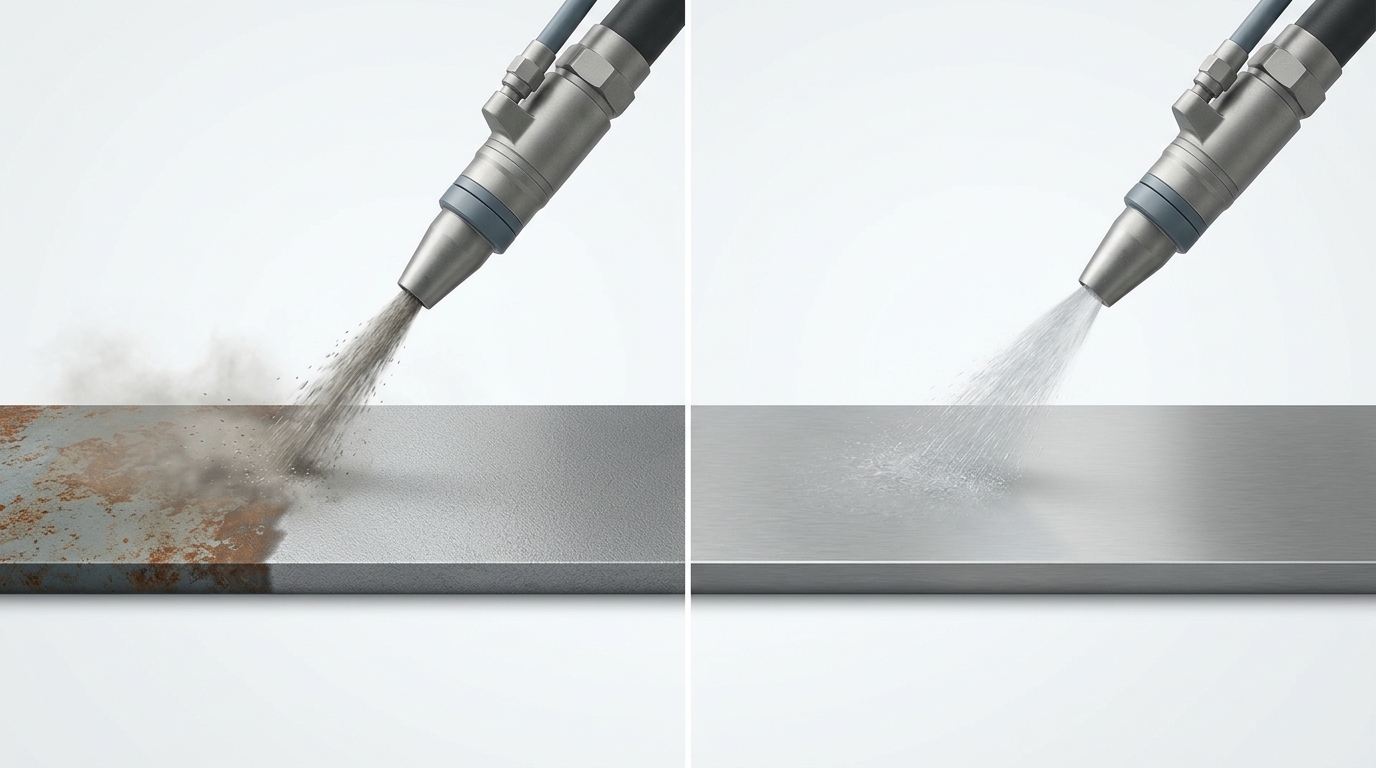
Dry Blasting: The abrasive is propelled directly onto the surface (without water) using compressed air or an injection system. It's fast and economical for jobs requiring high-speed, aggressive cleaning (heavy rust/scale/old paint removal, large surfaces) and requires no drying step. Its drawbacks are dust generation with fine-grained abrasives, the risk of localized heating, and in some cases abrasive embedment (contamination) into the surface.
Wet Blasting: The abrasive is mixed with water and propelled as a slurry. Water acts as both a carrier for the abrasive and a "cushion" that softens the impact energy. This eliminates dust generation (removing the risk of explosive dust/silicosis), minimizes localized heating, and produces a more homogeneous, controlled surface. Water also prevents abrasive granules from embedding into the surface, resulting in a cleaner finish and lower consumable usage. Its drawbacks are the need for a drying step and wastewater/sludge management.
When to Choose Which: Wet blasting is preferred for precision-toleranced parts (medical implants, aerospace components, casting molds), in environments where dust/spark risk is unacceptable (enclosed spaces, explosive atmospheres), and in applications where surface integrity (fatigue life, corrosion resistance) is critical. Dry blasting is better suited for fast, economical cleaning of large surfaces (ship hulls, steel structures, heavy rust/scale removal).
Process Control Parameters: Even with the right method selected, the actual determinant of the outcome is correctly setting the process parameters: abrasive shape/hardness/grain size, air pressure, (in wet systems) water-to-abrasive ratio and water temperature, number/diameter/angle of nozzles, distance to the part, and blasting duration. Each of these parameters directly affects the resulting surface roughness (Ra), coating adhesion, or fatigue resistance.
Comparison by Criteria:
| Criterion | Dry Blasting | Wet Blasting |
|---|---|---|
| Dust Generation | Present (especially with fine-grained abrasives) | None |
| Localized Heating | Higher | Low (water acts as a coolant/cushion) |
| Surface Homogeneity | Moderate | High |
| Abrasive Embedment Risk | Higher | Low (water prevents granule embedment) |
| Drying Requirement | None | Required |
| Waste Management | Dry dust/abrasive | Water/sludge treatment |
| Typical Application | Marine/steel structures, heavy rust/scale removal | Medical implants, aerospace, casting molds, precision surfaces |
Both methods are part of SAYKAR's product range; we can help you decide which one suits your operation based on part tolerance, surface requirements, and production volume.
Let's Find the Right Solution for Your Needs Together
Get in touch with us to learn more about our wet or dry blasting machines.