

August 18, 2026
Almen Test and Saturation Curve in Shot Peening Processes
Achieving the targeted fatigue life improvement and surface stress quality in shot peening requires the kinetic energy of the shot stream (peening intensity) to be set correctly. This intensity is standardized through the Almen Test and the Saturation Curve.
1. What Is the Almen Test?
The Almen test is the standard method used to measure the energy and intensity that the shot stream applies to a metal surface (per the SAE J443 and AMS 2430 standards).
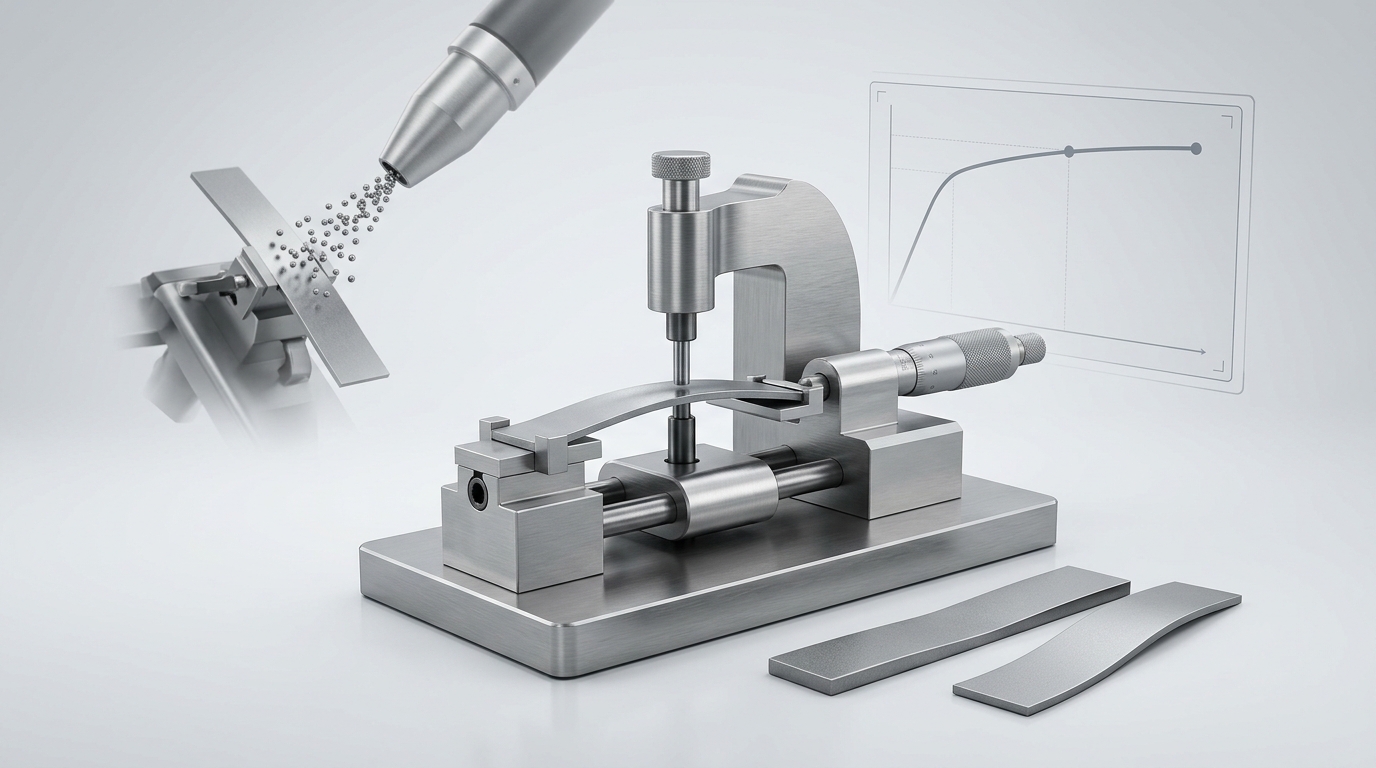
- Almen Strip: Spring-steel strips manufactured to standard dimensions and hardness. As the process runs, shot impacts on the strip's surface cause it to bow.
- Almen Gauge: After the process, the amount of bowing (arc height) that has developed in the strip is measured with a precision micrometer.
Almen Strip Types
Three different strip types are used depending on the hardness of the material being processed and the pressure applied:
| Strip Type | Thickness | Application / Intensity Range |
|---|---|---|
| N Strip | ~0.79 mm | Low-intensity applications (delicate / thin parts) |
| A Strip | ~1.29 mm | Medium-intensity general industrial applications (most common) |
| C Strip | ~2.39 mm | High-intensity heavy industry and casting applications |
2. What Is the Saturation Curve?
The Saturation Curve is a graph plotting the Almen arc heights obtained at different process times (or numbers of passes). A single Almen measurement only shows the intensity at that moment; the saturation curve is needed to determine whether the part has been sufficiently peened. As time increases, arc height first rises quickly, then the rate of increase slows and the curve flattens out — this flat region is called "saturation."
How Is the Saturation Point (T1) Determined? (SAE J443 Standard)
On the graph, the Saturation Point (T1) is the first point at which doubling the process time (2T1) produces an increase in arc height of 10% or less.
- Under-Peening (T<T1): Insufficient permanent compressive stress forms on the surface, and the part's fatigue life does not reach the expected level.
- Optimum Peening (T1): The ideal process time, providing maximum performance and efficiency.
- Over-Peening (T>2T1): Leads to micro-cracks, shot breakdown, and material deformation on the surface.
Key Advantages for Industry
- Quality Standardization: Ensures the same peening quality is maintained across different operators or shifts.
- Cost and Time Savings: Prevents unnecessarily long blasting times, reducing energy and shot consumption.
- Part Life Assurance: Enables surface treatment compliant with aerospace, automotive, and defense industry standards.
Contact us to determine the right Almen intensity and saturation parameters for your part.
Let's Determine the Right Shot Peening Parameters for Your Part Together
Get in touch with us to learn more about the Almen test, saturation curve, and process parameters.