

August 18, 2026
What Is Coverage in Shot Peening?
Achieving the targeted fatigue life improvement in shot peening isn't just about setting the correct Almen intensity — coverage, the measure of how much of the part's surface has been effectively peened, is an equally critical parameter.
1. What Is Coverage?
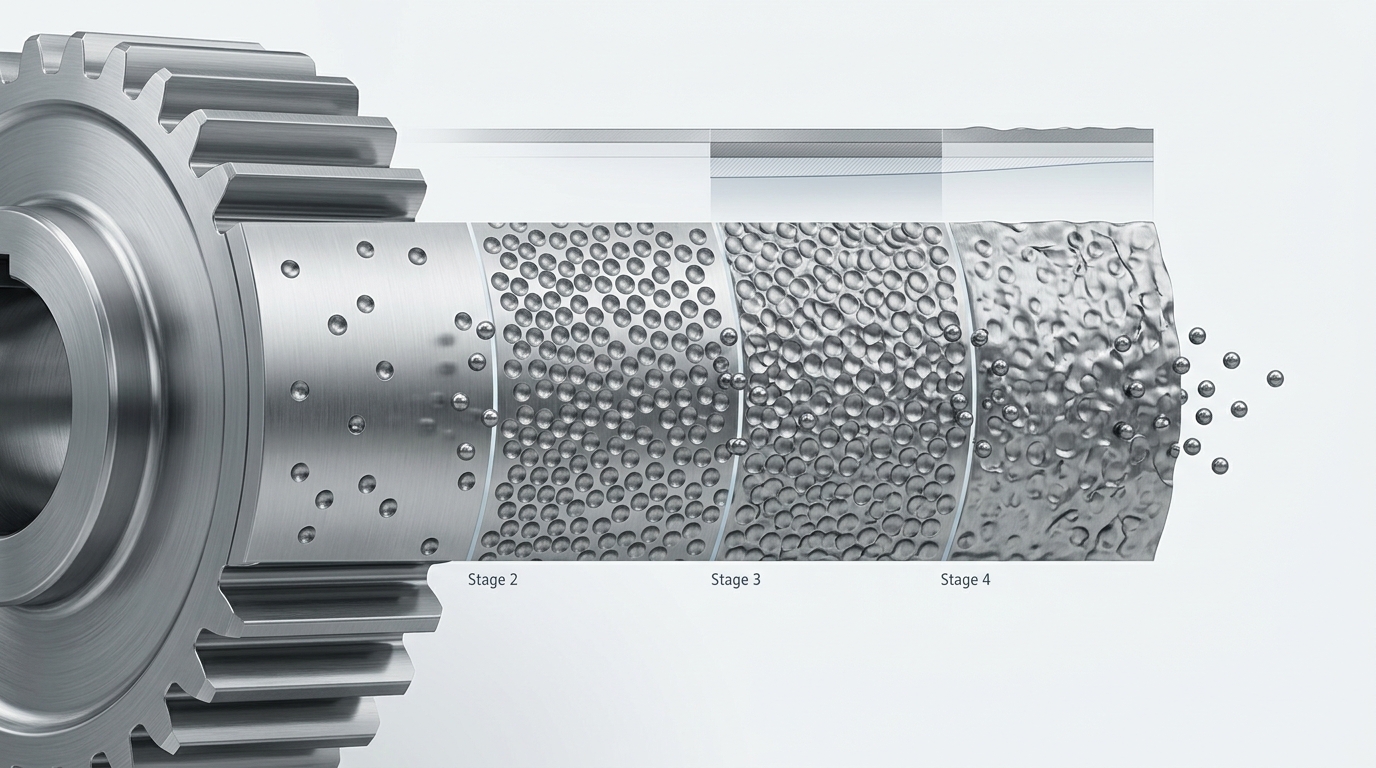
Coverage is the ratio of the plastic deformation dimples (craters) created during the shot peening process to the total surface area of the part.
- 100% Coverage: The entire surface of the part has been peened so that no gaps remain, as verified visually/optically.
- 200% or 300% Coverage: Achieved by extending the process time to 2 or 3 times (2T1, 3T1) the time (T1) at which full visual coverage was reached.
2. Why Isn't 100% Coverage Enough?
Even once 100% coverage is visually achieved, extending the process time further improves quality for the following reasons:
- Statistical Approach: Shot impacts follow a bell-curve (Gaussian) distribution. Extending the time is necessary to eliminate the remaining unpeened micro-gaps.
- Stress Saturation: Reaching the maximum subsurface compressive stress and increasing its depth requires additional energy/time.
- Peak Flattening: The sharp micro-crater edges created by the initial impacts are smoothed out by additional impacts, preventing stress concentration.
3. The Risks of Over-Peening
As seen in industrial applications on critical, high-fatigue-strength parts such as springs, gears, and crankshafts, determining shot peening parameters requires a process design specific to each part. Uncontrolled extension of the process time, however, can have the opposite effect:
- Excessive Plastic Deformation: Uncontrolled extension of the process time depletes the material's plastic deformation capacity at the surface.
- Surface Damage and Micro-Cracks: Excessive shot impact causes surface lapping and flaking, creating crack initiation points instead of improving fatigue life.
- Saturation Overshoot on the Almen Curve: When time/angle is not set correctly, Almen deformation values can exceed the target range; this can be brought back into the desired quality range through experimental parameter optimization (readjusting process times).
4. Controlling Coverage and Process Parameters
Industrial applications use the following control methods to keep coverage ratio and Almen values within the correct range:
- Angular Position and Time Matching: The shot spray angle and the nozzle's dwell time over the part must be precisely controlled with stepper motors and automation systems, matched to the part's geometry.
- Fluorescent Tracer Method (Peenscan): On complex part geometries, the time needed to reach 100% coverage is determined with the help of fluorescent tracer dyes.
- Verification with Almen Strips: Deformation amounts are measured on Almen strips before the process to verify timing and confirm the saturation point.
5. Summary Acceptance Criteria
| Coverage Level | Surface and Metallurgical Condition | Industrial Assessment |
|---|---|---|
| <100% | Unpeened micro-areas remain. | Insufficient (Unacceptable): Early fatigue risk. |
| 100% – 200% | Surface fully covered, compressive stress established. | Standard (Acceptable): Most industrial part standards. |
| 200% – 300% | Micro-gaps eliminated, maximum stress depth. | Optimum (Excellent): Resistant to high dynamic loads. |
| >300% – 400%+ | Excessive plastic deformation, surface lapping. | Over-Peening (Defective): Surface damage and reduced fatigue life. |
Correctly setting coverage together with Almen intensity is the key to reliably achieving the targeted fatigue life improvement from a shot peening application. Contact us to determine the right coverage and process parameters for your part.
Let's Determine the Right Shot Peening Parameters for Your Part Together
Get in touch with us to learn more about coverage, Almen intensity, and process parameters.